Slope Rating vs Course Rating: Is a Higher Slope Harder?
Slope rating runs from 55 to 155, with 113 as standard. A higher slope is harder for bogey golfers. Course rating is what a scratch golfer should shoot.
By Flighting Editorial Team
Key Takeaways
- Course rating is the score a scratch golfer (index 0.0) should shoot from a given set of tees in normal conditions. It is often a stroke or two away from par.
- Slope rating measures how much harder the course plays for a bogey golfer than for a scratch golfer. It runs from 55 to 155, and 113 is standard.
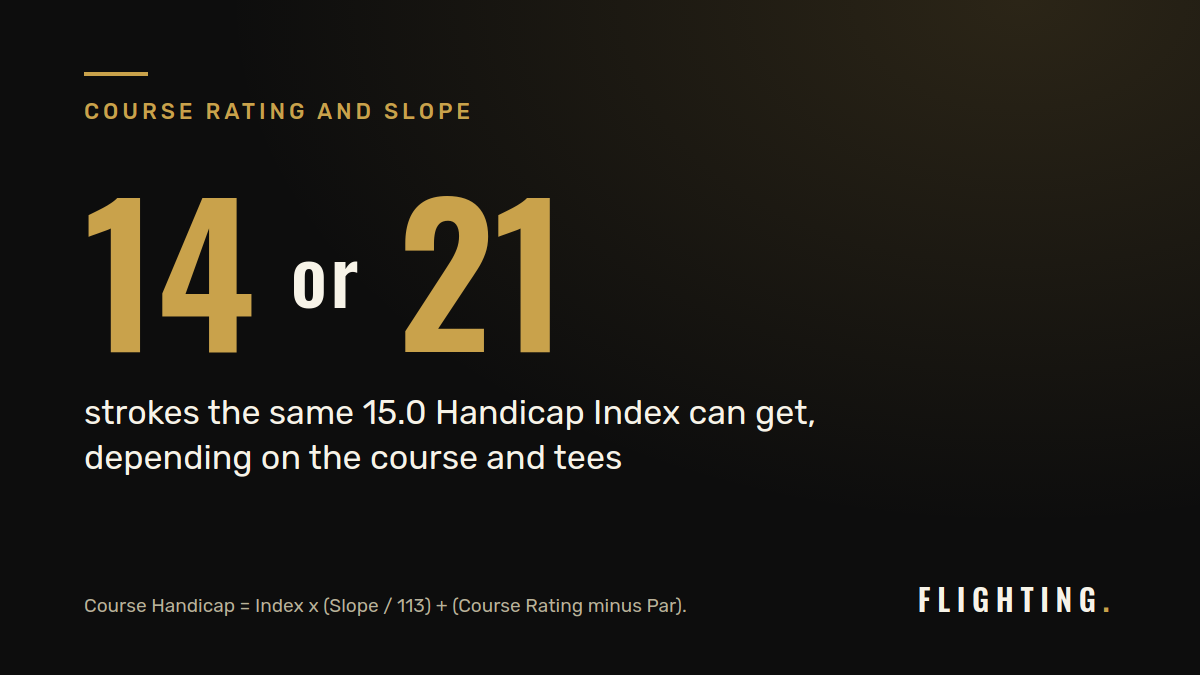
- Your Course Handicap equals Handicap Index x (Slope / 113) + (Course Rating minus Par). The same 15.0 index can mean 14 strokes on one course and 21 on another.
- Flighting members typically shoot 2 to 4 strokes more over par than their index. That gap is normal, because your index tracks your better rounds.
Slope rating measures how much harder a set of tees plays for a bogey golfer than for a scratch golfer, on a scale from 55 to 155 with 113 as standard. So yes, a higher slope is harder, mostly for higher handicaps. Course rating is the score a scratch golfer should shoot. Together they set your strokes for the day.
What is course rating in golf?
The USGA defines course rating as the score a scratch player, someone with a Handicap Index of 0.0, should shoot on a good day under normal course and weather conditions. Every set of tees has its own rating, and men's and women's ratings differ from the same tees.
Par only counts the strokes a hole is designed for. Rating measures how hard the course actually plays. Raters look at length and at the obstacles: how wide the landing areas are, how much trouble sits near them, how firm and fast the greens are, and how much elevation and forced carry is involved. So two par 72 courses can be rated 69.8 and 74.6. On the first, a scratch player should beat par by about two shots. On the second, they should finish nearly three over.
If you learned the game in Great Britain or Ireland, course rating is the number that replaced the old standard scratch score (SSS) when the World Handicap System arrived there in November 2020.
What is a bogey rating?
Raters also produce a bogey rating: the expected score for a bogey golfer. The USGA sets the male bogey golfer at roughly a Course Handicap of 20 on a course of standard difficulty and the female bogey golfer at roughly 24. You rarely see the bogey rating on a scorecard, but slope is built from it.
What is slope rating in golf?
Slope rating measures relative difficulty. It answers this question: how much more does this course punish a bogey golfer than a scratch golfer? Per the USGA slope rating FAQ, the lowest possible slope is 55, the highest is 155, and a course of standard difficulty is 113.
How is slope calculated?
Slope is the gap between the bogey rating and the course rating, multiplied by a constant: 5.381 for men and 4.24 for women. Suppose a men's tee is rated 71.0 with a bogey rating of 96.0. The gap is 25 strokes, and 25 x 5.381 is about 135. That number tells you the course gets much harder as skill drops, usually because of forced carries, narrow fairways with real trouble, or long approach shots that shorter hitters cannot reach.
What do slope numbers feel like on the course?
- Slope in the 100s to about 115: open fairways, few forced carries, trouble you can usually play around. A missed shot costs a bogey golfer about what it costs a good player.
- Slope about 120 to 135: some carries, tighter driving holes, more bunkers protecting greens. Higher handicaps start to feel it.
- Slope 135 and up: long carries over hazards, penalty areas close to fairways, demanding greens. A bogey golfer's misses get expensive fast.
A common misread is that a low slope means an easy course. It doesn't. A course with a high rating and a modest slope is hard for everyone in roughly equal measure. Slope is about the gap between players, not overall difficulty.
Is a higher slope rating harder?
Yes, for anyone who isn't scratch. A higher slope means the course punishes missed shots harder as the handicap goes up, and the handicap math hands out more strokes to make up for it. The short version of course rating vs slope: rating tells you how hard the tees play for a scratch golfer, and slope tells you how much harder they get for everyone else.
Is a 135 slope rating hard?
A 135 sits 22 points above the 113 standard, so it plays well above average difficulty for a mid or high handicapper. You can see it in the strokes. A 15.0 index scales to 15.0 x 135 / 113 = 17.9 before the rating adjustment, about three more strokes than on a 113 course. At the top of the scale, 155, the same index scales to 20.6. At a slope of 128 it scales to 17.0.
| Slope rating | 15.0 index x slope / 113 | Strokes vs a 113 course |
|---|---|---|
| 100 | 13.3 | about 2 fewer |
| 113 | 15.0 | same |
| 128 | 17.0 | about 2 more |
| 135 | 17.9 | about 3 more |
| 145 | 19.2 | about 4 more |
| 155 | 20.6 | about 6 more |
Those extra strokes exist because the rating team expects a bogey golfer to lose them. If you shoot your normal score on a 135 course, you played better than usual.
How do course rating and slope affect your course handicap?
Your Handicap Index is portable. Your Course Handicap is the number of strokes you get from a specific set of tees. The USGA formula is:
Course Handicap = Handicap Index x (Slope Rating / 113) + (Course Rating minus Par)
A worked example: same golfer, two courses
Take a golfer with a 15.0 index and two par 72 courses.
| Step | Course A (rating 70.1, slope 118) | Course B (rating 74.3, slope 141) |
|---|---|---|
| Index x slope / 113 | 15.0 x 118 / 113 = 15.66 | 15.0 x 141 / 113 = 18.72 |
| Plus (rating minus par) | 70.1 minus 72 = minus 1.9 | 74.3 minus 72 = plus 2.3 |
| Course Handicap | 13.76, rounds to 14 | 21.02, rounds to 21 |
Same player, seven strokes apart. The slope term does most of the work on Course B, and the rating term pushes it up again because a scratch player is expected to shoot over par there. This is why picking up your strokes from the course's chart, or working them out yourself, matters every time you play somewhere new.
How does course rating affect your handicap index?
Rating and slope also run in the other direction. Every posted score becomes a score differential, using the formula on the USGA score differential FAQ:
Score Differential = (113 / Slope Rating) x (Adjusted Gross Score minus Course Rating minus PCC adjustment)
The PCC (playing conditions calculation) is usually zero. It moves only when scores on a given day run far from normal, for example in heavy wind.
Why a 92 can beat an 88
Use the two courses above. An 88 on Course A gives (88 minus 70.1) x 113 / 118 = 17.1. A 92 on Course B gives (92 minus 74.3) x 113 / 141 = 14.2. The 92 is the better round by almost three strokes of differential, and it helps your index more. Your index is built from the best 8 of your most recent 20 differentials, which our guide to calculating your golf handicap walks through step by step.
Why do I shoot higher than my handicap?
Almost everyone does, and the numbers show it. We compared the gross scores of Flighting members against the par on their hole-by-hole scorecards, grouped by current Handicap Index. The data covers 6,076 rounds from 551 members in 2026.
| Handicap index band | Members | Rounds | Average index | Median strokes over par |
|---|---|---|---|---|
| Under 5 | 184 | 2,172 | 1.5 | +5 |
| 5.0 to 9.9 | 161 | 1,860 | 7.2 | +10 |
| 10.0 to 14.9 | 95 | 987 | 12.5 | +16 |
| 15.0 to 19.9 | 59 | 549 | 17.3 | +21 |
| 20.0 to 24.9 | 29 | 320 | 22.1 | +24 |
| 25.0 and up | 23 | 188 | 30.9 | +35 |
In most bands the typical round lands 3 to 4 strokes further over par than the average index (the 20.0 to 24.9 band is closer, at about 2). There are two reasons. Your index comes from your best 8 of 20 differentials, so it describes a good day, not an average one. And your index is measured against course rating and slope, not par, so on a tough course your Course Handicap is higher than your index anyway. Our member data stores card par but not each course's rating and slope, so this table compares against par only. If you're newer to the game and want to know what to aim for, see our guide to a good golf handicap for a beginner.
Card par is fairly uniform in the data: 68.4% of these rounds were on par 72 cards, 21.5% on par 71 and 8.1% on par 70. Course rating is where courses really differ. On home courses versus away courses, the 303 members with at least three rounds of each scored 0.7 strokes higher on average away from home (5,986 rounds). That gap is small. Knowing a course is worth less than most golfers think, while the difference in rating and slope from one course to the next can be worth several strokes, as the seven-stroke swing in the example above shows. Our post on why playing new courses helps has more on the home and away split.
How do you use course rating and slope to pick tees and judge rounds?
Choosing the right tees
Look at the rating and slope for each set of tees on the scorecard. If you are a mid handicapper and the back tees carry a slope above 135 with a rating well over par, you will spend the day hitting long irons and hybrids into par 4s. A better test: pick the tees where most par 4 approaches leave you a 9-iron through 6-iron. Moving up a set does not cost you anything in handicap terms, because the rating and slope for those tees take care of the math.
Judging a round
Compare differentials, not raw scores. A round that feels mediocre on a high-slope course can be one of your best of the year. Track the differential for every round and your trends get much easier to read.
If you want that done for you, Flighting pulls in your posted rounds and tracks your scoring trends over time, so a tough-course 92 and an easy-course 88 sit side by side in context.
Frequently Asked Questions
What is a good slope rating for a golf course?
There is no good or bad slope. A course of standard difficulty is 113, and the higher the number, the more the course punishes higher handicaps compared with scratch players.
Is a higher course rating harder?
Yes. A higher course rating means a scratch golfer is expected to shoot a higher score, so a 74.5 plays harder than a 70.5 even when both courses are par 72.
Who sets course rating and slope?
Trained rating teams from state and regional golf associations rate courses using the USGA Course Rating System. Courses are re-rated periodically and after significant changes such as new tees or redesigned holes.
Does slope rating affect my handicap index?
Yes. Every score differential is multiplied by 113 divided by the slope, so the same score over course rating produces a lower differential on a high-slope course than on a low-slope one.
Why is my course handicap different from my handicap index?
Your Course Handicap adjusts your index for the specific tees you are playing. It scales your index by slope divided by 113 and then adds the difference between course rating and par.
Join Flighting to track your rounds and unlock rewards.