How Long Does a Round of Golf Take? (9 and 18 Holes)
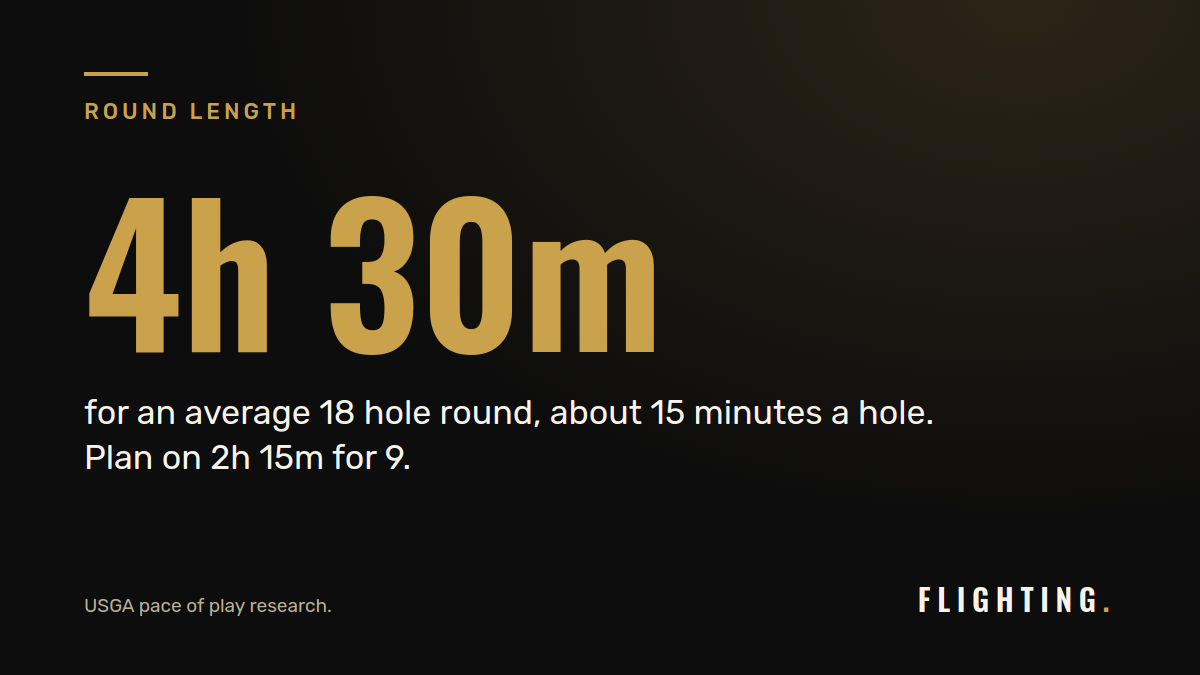
An 18-hole round averages about 4 hours 30 minutes, roughly 15 minutes a hole. Here's how long 3, 4, 9 and 18 holes take, and what group size changes.
By Flighting Editorial Team
Key Takeaways
- USGA research puts the average 18-hole round at about 4 hours 30 minutes, which works out to roughly 15 minutes a hole.
- At that pace, 9 holes takes about 2 hours 15 minutes, 4 holes about an hour, and 3 holes about 45 minutes.
- The number of balls in play matters more than the number of people: USGA match play pace limits run from 3 hours 58 minutes for two players to 4 hours 54 minutes for four.
- Higher handicaps take longer because they hit more shots. Flighting members at 25.0 and up average about 28 more strokes per round than members under 5.
A round of golf takes about 4 hours 30 minutes for 18 holes, according to recent USGA pace-of-play research. That's roughly 15 minutes per hole, so 9 holes takes about 2 hours 15 minutes. A twosome on an open course can be much faster; a full tee sheet on a Saturday is usually slower.
How long does 18 holes of golf take?
Plan on four and a half hours from first tee to last putt, plus whatever time you spend warming up and in the clubhouse. The USGA reports that the average round has grown to 4 hours 30 minutes, a new high.
That's an average across courses, days and groups, not a target. Plenty of foursomes finish in about four hours on a weekday morning, and plenty take five on a busy weekend afternoon. The pace you get depends far more on the groups ahead of you than on your own group.
If you need to be somewhere afterward, book a time that leaves you five hours, and add the warm-up on top. Our 10-minute warm-up is built for exactly the golfer who arrives with no time to spare.
How long does 9 holes of golf take?
About 2 hours 15 minutes at the average 18-hole pace. Nine-hole rounds often run a little quicker in practice, because many courses send nine-hole players out late in the day or on quieter loops, but use 2 hours 15 minutes for planning.
How long do 2, 3, 4 or 12 holes of golf take?
Use 15 minutes a hole as the baseline. That number comes straight from dividing the USGA's 4 hour 30 minute average by 18, so treat it as a planning figure, not a measurement for your course.
| Holes | Time at 15 minutes a hole |
|---|---|
| 1 hole | About 15 minutes |
| 2 holes | About 30 minutes |
| 3 holes | About 45 minutes |
| 4 holes | About 1 hour |
| 6 holes | About 1 hour 30 minutes |
| 9 holes | About 2 hours 15 minutes |
| 12 holes | About 3 hours |
| 18 holes | About 4 hours 30 minutes |
Par 3s go faster than par 5s, so a stretch of short holes will beat the table and a stretch of long ones won't. If you're squeezing in holes before dark, the table is a fair guide to how far you'll get.
How long does a round of golf take for 2, 3 or 4 players?
The clearest official numbers come from USGA team competitions, which set a maximum pace for each match format over 18 holes. The USGA pace-of-play limits are:
- Singles match (2 players, 2 balls): 3 hours 58 minutes
- Foursomes match (4 players, 2 balls, alternate shot): 4 hours 6 minutes
- Four-ball match (4 players, 4 balls): 4 hours 54 minutes
Look at the middle line. Four players hitting alternate shot are only eight minutes slower than two players, because there are still only two balls in play. Going from two balls to four adds almost an hour. Time is driven by how many shots get hit, not how many people walk the course.
Those are limits for championship play on demanding setups. A casual twosome on an open course can be well under them. But a twosome can only go as fast as the group ahead, so on a full tee sheet, expect your twosome or threesome to finish close to the foursomes around you unless you're allowed to play through.
Does your handicap change how long a round takes?
Yes, because higher handicaps hit more shots. We pulled the average 18-hole score by Handicap Index band from 10,349 rounds posted by 692 Flighting members between January and September 2026.
| Handicap Index | Members | Rounds | Average score |
|---|---|---|---|
| Under 5 | 221 | 3,652 | 76.5 |
| 5.0 to 9.9 | 205 | 3,310 | 82.7 |
| 10.0 to 14.9 | 128 | 1,758 | 88.3 |
| 15.0 to 19.9 | 77 | 942 | 92.6 |
| 20.0 to 24.9 | 32 | 399 | 96.4 |
| 25.0 and up | 27 | 268 | 104.3 |
A member at 25.0 or above averages about 28 more strokes per round than a member under 5. Put four of each in a group and that's over 110 extra shots across 18 holes, each with its own walk, club choice and routine. Higher scores also come with more searches and more penalty drops.
None of that means higher handicaps are the reason a course is slow. A lot of lost time happens between shots, not during them. A 100-shooter who plays ready golf can keep up with an 80-shooter who doesn't. Picking up when you hit net double bogey in a casual round, which still counts for handicap posting, is one of the easiest ways to keep moving. We cover that in our guide to golf etiquette and pace.
Is golf faster with a cart or walking?
A cart is faster between shots when it's used well and slower when it isn't. Two players sharing a cart who drive to one ball, drop the other player with two or three clubs, and then go to their own ball move quickly. Two players who ride to the first ball, wait, and then ride across the fairway to the second ball give most of that time back.
Cart-path-only days change the math. Every shot from the middle of the fairway means a walk to and from the path, so carry a club either side of your yardage. On a flat course with a light bag or push cart, walking groups can match riding groups, because each player goes straight to their own ball.
The course matters too. Long gaps between greens and the next tee favor carts. Compact layouts favor walkers. If you're timing a round with a cart, use the same 15 minutes a hole and adjust after a few rounds at your own course.
What slows a round of golf down?
- The groups ahead. On a busy course this sets your pace more than anything you do.
- Ball searches. The Rules allow three minutes to search, under Rule 18.2. A few long searches a round add up fast.
- Waiting to get ready. Players who only start picking a club when it's their turn add time on every shot.
- Cart-path-only days. Walking back and forth to the cart with the wrong club costs minutes per hole.
- Long pre-shot routines. Several practice swings and a long read on every putt add up over 70 to 100 shots.
How do you play a faster round of golf?
The Rules of Golf, Rule 5.6, recommend that a player make each stroke in no more than 40 seconds once it's their turn and nothing is in the way, and they encourage ready golf in stroke play. Those two ideas cover most of it:
- Get ready while others play. Yardage, club and target picked before it's your turn.
- Play ready golf. In stroke play, whoever is ready and safe hits first.
- Keep your routine short. One practice swing, then hit. Our guide to a pre-shot routine that works under pressure fits comfortably inside 40 seconds.
- Hit a provisional. If your ball might be lost or out of bounds, hit a provisional before you walk forward.
- Take two or three clubs to the ball on cart-path-only days.
- Keep up with the group ahead. If the hole in front of you is clear and you're still on the tee, you're behind.
If you post your rounds in Flighting, you'll see your score trend over the season, and a lower score is the most reliable way to a shorter round.
Frequently Asked Questions
How long does it take to play 18 holes of golf?
About 4 hours 30 minutes on average, based on USGA research. Weekday mornings and small groups can be quicker, and busy weekend afternoons are often slower.
How long does 9 holes of golf take?
Plan for about 2 hours 15 minutes, which is half the 18-hole average. Quiet times of day and small groups can bring it down.
How long does it take to play 3 or 4 holes of golf?
At the average pace of about 15 minutes a hole, 3 holes takes about 45 minutes and 4 holes about an hour.
How long does a round of golf take for 2 players?
Two players can finish well under four hours on an open course; the USGA's competition limit for a two-player singles match is 3 hours 58 minutes. On a busy course, a twosome moves at the pace of the groups ahead.
How long should each shot take in golf?
The Rules of Golf recommend no more than 40 seconds per stroke once it's your turn and you can play without interference. Most players can be quicker than that.
Join Flighting to track your rounds and unlock rewards.